
The Appledore Tapestry – A Thousand Years of Village History
A remarkable piece of local history at St Peter and St Paul’s Church
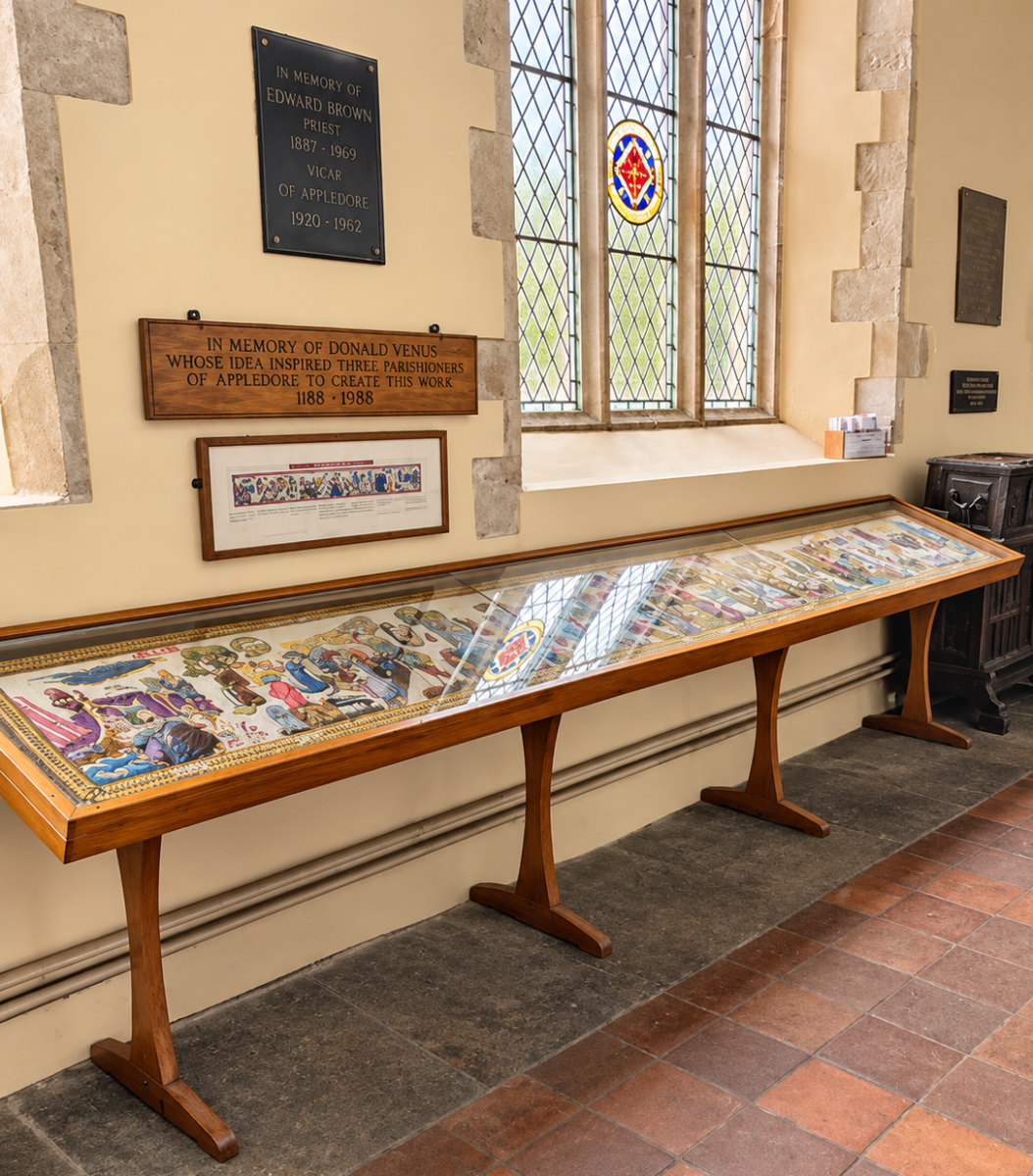
Visitors to St Peter and St Paul’s Church in Appledore may have noticed a colourful tapestry displayed on the church wall, accompanied by a commemorative plaque and a guide explaining the historical events depicted within it.
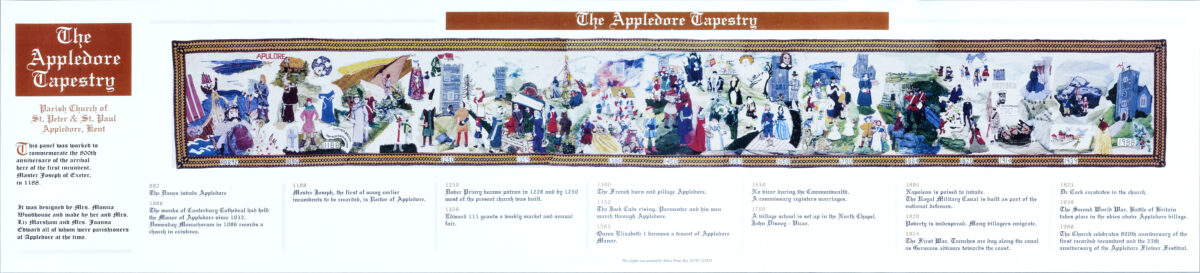
The tapestry is a particularly special part of Appledore’s heritage. Created in 1988, it was designed to commemorate 800 years since the appointment of the first recorded incumbent (or Rector) of the parish in 1188. It brings together more than a thousand years of local history, illustrating some of the people, events and circumstances that have shaped Appledore and the surrounding area.
Rather than simply recording dates, the tapestry provides a visual journey through the village’s past, from the arrival of the Danes in the ninth century to the celebration of the church’s 800th anniversary in 1988.
The story behind the tapestry
The idea for the tapestry came from Donald Venus, an Appledore resident, whose inspiration encouraged three parishioners to undertake the creation of this substantial piece of work.
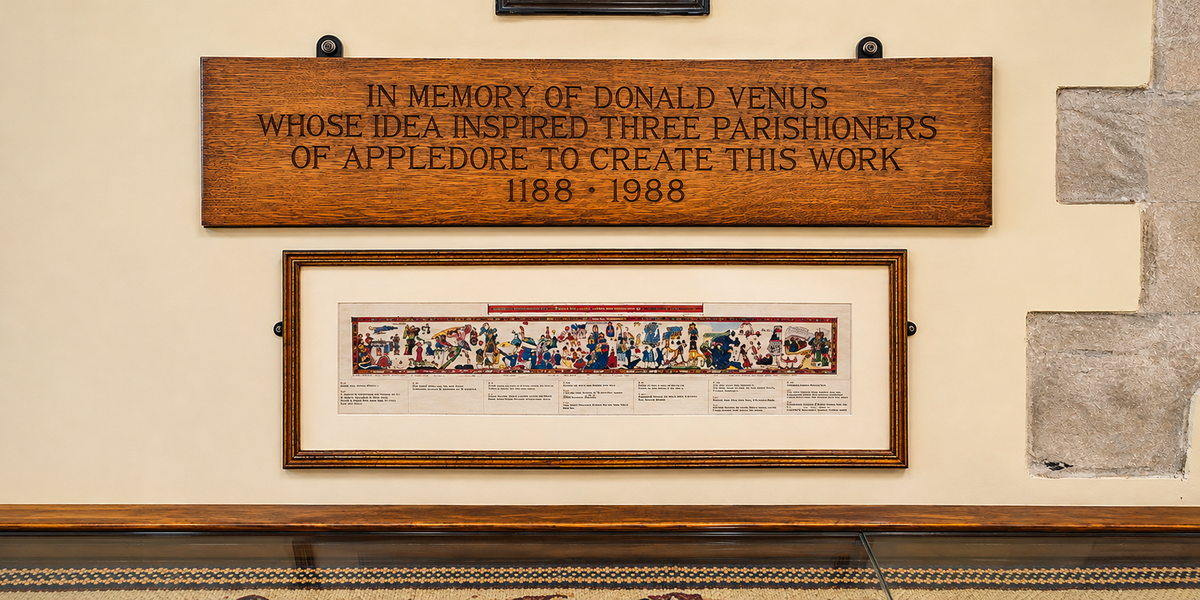
A commemorative plaque displayed immediately above the tapestry reads:
“In memory of Donald Venus, whose idea inspired three parishioners
of Appledore to create this work.
1188–1988.”
The tapestry was created by three ladies from Appledore who had the skills to undertake the considerable task of bringing Appledore’s history to life through needlework. Mrs Monica Woodhouse designed the historical scenes and specialised in applique and collage, Mrs Liz Marsham and Mrs Joanna Edward, who worked in petit point, crewel work and black work.
The choice of 1188 was significant. This was the year of the first recorded appointment of the Rector, Master Joseph of Exeter. The tapestry therefore celebrated eight centuries of recorded church history, while also looking much further back into the story of Appledore itself.
An accompanying guide enables visitors to follow the historical events represented in the individual sections of the tapestry and understand their significance.
The church that houses the tapestry
St Peter and St Paul’s Church has itself played a central part in Appledore’s history for many centuries.
The Domesday Book of 1086 records that Appledore already had a church, although the building we see today is considerably later. The present church is generally dated to the early thirteenth century, with some evidence suggesting that it developed from an earlier Norman building.
The church is Grade I listed and is particularly interesting architecturally because of its unusual layout and mixture of medieval features.
Some of its oldest surviving parts include the substantial west tower and the north chapel, which date from the thirteenth century. The north chapel has had several uses over the centuries, including as a schoolroom, vestry and organ chamber.
The church suffered considerable damage during the French raid on Appledore in 1380. Much of the building was subsequently rebuilt, incorporating surviving earlier sections. This explains why the church contains such a mixture of architectural styles and why its appearance is rather different from that of many other parish churches.
A major restoration and refurbishment took place in 1925, helping to preserve the building for future generations.
Today, St Peter and St Paul’s remains an important part of village life, serving not only as a place of worship but also as a repository of Appledore’s history and heritage.
Following the history depicted in the tapestry
The tapestry provides a fascinating chronological account of events associated with Appledore. Its historical guide highlights the following milestones.
The early medieval period
892 – The Danes invade Appledore
Appledore was caught up in the Danish invasions of England during the reign of King Alfred the Great. The Anglo-Saxon Chronicle records the arrival of a substantial Danish force in the area in 892.
1086 – Domesday Book
The Domesday survey records the manor of Appledore as belonging to the monks of Christ Church, Canterbury. It also confirms that the village already had a church.
1188 – Master Joseph
The first recorded incumbent of Appledore, Master Joseph, is appointed. This date is particularly important as it provided the 800-year anniversary commemorated by the tapestry.
Medieval Appledore
1250 – Dover Priory
Dover Priory had become the patron of the church by this period. The guide records that the present church was built around this time, although parts of the surviving building are earlier.
1359 – Market and annual fair
Edward III grants Appledore the right to hold a weekly market and an annual fair, reflecting the village’s importance as a local centre of trade.
1380 – The French raid
French forces attack and burn much of Appledore. The church is badly affected and subsequently undergoes substantial rebuilding.
1450 – Jack Cade’s rebellion
The rebellion led by Jack Cade brought considerable unrest to Kent and the surrounding area. His followers marched through Appledore during this period of national upheaval.
Tudor and Stuart times
1583 – Queen Elizabeth I
Queen Elizabeth I becomes tenant of Appledore Manor, an interesting connection between the village and the Tudor monarchy.
1650 – The Commonwealth
During the Commonwealth period, the guide records that there was no vicar at Appledore. A commissary undertook the registration of marriages.
The eighteenth and nineteenth centuries
1700 – A village school
A village school is established in the North Chapel of the church. The guide associates this development with John Disney, the vicar of Appledore.
1804 – The threat of Napoleon
With Britain facing the threat of invasion by Napoleon’s forces, the Royal Military Canal is constructed as part of the country’s coastal defences.
The canal, built between 1804 and 1807, runs through the Appledore area and remains an important feature of the local landscape.
1820 – Poverty and emigration
The guide records widespread poverty during this period, with many Appledore villagers leaving the area in search of better opportunities.
The twentieth century
1914 – The First World War
The Royal Military Canal once again became significant in Britain’s defence preparations. Trenches were dug along the canal as fears grew about a possible German advance towards the south coast.
1925 – Archaeological investigations
The guide records Dr Cock excavating the nave and Horne Chapel, adding to our understanding of the church and its history.
1939 – The Second World War
Appledore once again experienced the effects of international conflict, with the village and surrounding area caught up in the events of the Second World War.
1988 – The church’s 800th anniversary
The church celebrates 800 years since the appointment of its first recorded incumbent in 1188. The tapestry, created by three local ladies and inspired by Donald Venus, provides a lasting commemoration of this milestone.
A tapestry that tells the story of a village
One of the most appealing aspects of the Appledore Tapestry is the way it brings together events that might otherwise seem unrelated.
It reminds us that Appledore has experienced invasions, rebellion, poverty, changes in religion, threats of war and considerable changes in everyday village life. It also illustrates the importance of the church as a constant presence throughout these centuries.
The tapestry is particularly valuable because it represents the efforts of local people who wanted to preserve and celebrate their village’s history.
The next time you visit St Peter and St Paul’s Church, take a moment to look at the tapestry and its accompanying guide. Each section has a story to tell, and together they provide a fascinating glimpse into more than a thousand years of Appledore’s past.
Our thanks to those who conceived, designed and created this wonderful piece of local history, ensuring that an important part of Appledore’s story would be preserved for future generations.